Saturday, July 7, 2012

Friday, June 15, 2012
THE BATTLES CONTINUE
-->
-->
IMPROVISATION, BY BERNIE KATZMAN
-->
Abraham Lincoln won the election for the presidency in 1860,
despite the fact that he was not on the ballet in many southern states, His election
culminated many years of what came to be known as “sectionalism” (meaning loyalty to the
interest of ones own district rather to the nation as a whole), especially over
the issue of slavery.
Lincoln’s election
ultimately spurred ten states of the “Deep South” to declare its secession from the United States.. South Carolina (December 20,1860), Mississippi (January 9, 1861)
Florida (January 10,1861), Alabama (January 11, 1861), Georgia (January
19,1861), Louisiana, (January 26, 1861), Texas, (February 1, 1861), Virginia
(April 17,1861, Arkansas, May 6,1861, North Carolina, May 20, 1861, Tennessee
June 8, 1861), formed what came to be called The Confederate States of
America. Four slave holding
states,Kentucky, Maryland, Delaware and Missouri did not declare secession and remained
loyal to the United States. A portion of Virginia broke away, remained loyal
to the United States union, and became a new state known as West Virginia.
The Civil War began after the attack and capture by
Confederates of the US federal Forth Sumter on April 12, 1861. The war lasted until 1865 and was one of
the bloodiest wars ever fought by Americans, and the third war fought on
American soil. (The Mexican War of 1848 was technically fought on Mexican territory which was annexed to the United States at the end of the war.) Enslaved people were freed as a result of the Civil war. The
thirteenth amendment to the Constitution forbids slavery in the United States.
Harriet Tubman was an active participant in the Civil War.
Having had experience as conductor on the Underground Railroad, she knew her
way around the land, how to hide, how to disguise herself. She was an expert organizer and had many scouts working with
and for her. She was
also a nurse who knew natural
remedies, for example, some home remedies for dysentery which was a common ailment among union
soldiers. Her courage and determination were extremely helpful to the
Union.
Harriet Tubman continued her activism after the Civil War.
She was especially dedicated to the cause of Woman’s Rights in general and the
woman’s suffrage movement in particular. She spent her last years building and working at a home for the elderly.
She died in Auburn New York in 1913. Her gravestone reads:
Harriet Tubman Davis, Heroine of the Underground Railroad,
nurse and scout in the Civil War. Born about 1820 in
Maryland, died March 20, 1913 at Auburn,NY.
nurse and scout in the Civil War. Born about 1820 in
Maryland, died March 20, 1913 at Auburn,NY.
“SERVANT OF GOD, WELL DONE.”
INSTRUMENTAL
LYRICS
The civil war a
long time fought
Misery is what it wrought
Nursing the wounded, the hours were long
A spy for the union my will was strong.
The war now
over, the slaves free at last.
Now we must move from an ugly past,
Though it’s time to lay down the gun,
Other battles continue more to be done.
I’ll fight those fights for humankind,
Devote my heart and the whole of my mind,
Helping people take a stand,
Pushing for justice in our land.
I “ll crusade both day and night
The battles continue, turn wrong to right,
Has always been my destiny,
It’s my mission, always shall be
Sunday, May 6, 2012
BREATHE FREE
Communication was usually severed and it was not uncommon for a family members never to hear from those sold away ever again. In this segment, Jim heard that he was to be sold. He decides to run away. He promises to come back for Sarah and their child..but he was captured, and sold anyway.
LYRICS
Jim's part
Sarah, Sarah, Sarah my darlin'..
Just as soon as the sun sets in the sky.
I must go, I must run away to night.
It's mighty hard, so hard to say good-bye.
Sarah's Part
Jim, Jim, Jim my darlin,
Though we promised, from the very start.
That we would stay, together forever.
We would never, never ever part.
And yet I know, I know it to be true.
That if you stay, I fear what they will do.
They'll sell you down south, so far away from me.
Then neither one of us would ever breathe free.
Jim's Part
Remember, Sarah, Sarah my darlin,
I promise this, it's what I plan to do.
I somehow will, I'll come back here for you.
And our child, come back for her too.
Cause I'll find a way to rescue you.
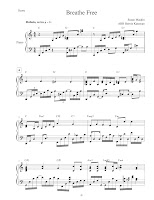
Then both of you, like me, will breathe free air too.IMPROVISATION,by Bernie Katzman
Please click the music below for the entire transcription
Tuesday, April 24, 2012
-- WHAT YA' DOIN' MINTY
As
a young girl, Minty was often "hired out." This means she was put to
work for other families in some capacity. In one case, for example, she
was hired out to a weaver...a woman who mistreated her terribly. Minty was beaten on a regular basis. At one point she had the
measles, but was still made to work. It was at this time she was able to
get back to her mother who nursed her back to health.
Although some enslaved people found ways of making a little money, most were penniless. There were a few people who, with some meager savings and money donated by abolitionists, were able to buy their freedom..but this was rare.
Many of the "owners" of enslaved
people were small farmers, "owning" two or three people. The larger
plantations might have had many workers. There were some Black slave
"owners", probably accounting to fewer than 2%. These were free Black
people living in the south as well. Though some "owned" the enslaved people for
commercial reasons, a good many were known as "benevolent slave
owners." They bought slaves to enable them a better, more tolerable
life; they bought family members, to keep them together; they bought
them in order to free them (manumission.)
The facts of Minty's early life are sketchy. A few incidents are known however.. Harriet herself retained some memories and was known, in her senior years, to speak to children about her life . One of her distinct memories was of an infant's bed, carved out of a tree, presumably by her father. She also remembered, as a young child , being played with (tossed up and down) by some white girls.
As a child, Minty/Harriet was severely injured when a hard object thrown
towards another enslaved person, accidentally hit her head leaving a
physical scar . Fainting spells plagued her for the rest of her life. Beatings, mutilations and other severe treatment was suffered by the enslaved people if they committed even the most minor of offenses.
Minty replies by telling her mother and sister about her longing to be free, and her intentions to break away from her present condition. She tells them that it is not just a dream, but is on her mind as a reality for the future. This song represents both the feelings of hopelessness and yet the yearnings to be free in spite of despair. The song, therefore, is symbolic.
In actuality, as far as we know, Minty's mother, Rit, had a strong , courageous, rebellious spirit of her own as did so many of the enslaved people. It is thought that when her youngest son, Harriet's brother, was to be "sold", Rit
hid him for a month until the "sale" was abandoned.
PLEASE CLICK ON THE ORANGE CIRCLE WITH THE WHITE ARROW TO HEAR THE MUSIC FOR THE SONG. THE LYRICS FOLLOW.
Lyrics
.....MOTHER'S PART
......What ya doin' Minty, Sittin' in the corner?
......Get yourself goin', There's work to be done.
......Get yourself goin', There's work to be done.
......The missus don't like ..........No lazy slave girl ,
......There aint no rest here, Never fun.
......There aint no rest here, Never fun.
.......MOTHER'S AND SISTER'S PART
.......Com-on, Minty, Get ya-self movin'
.......Life don't change, oh can't ya' see,
.......Plantations for us is sure not free,
.......And won't ...............never be.
.......Life don't change, oh can't ya' see,
.......Plantations for us is sure not free,
.......And won't ...............never be.
......MINTY'S PART
......It aint no fair mama, workin' like a cart horse
......Livin' for the big house, night and day.
......Livin' for the big house, night and day.
,,,,,,I needs to be free, be my own master,
,,,,,,For me, it's the only way.
......I know in my heart......I'm headin' for freedom
,..,,,Ain't just a dream, ....it's on my mind
,,,,,,For me, it's the only way.
......I know in my heart......I'm headin' for freedom
,..,,,Ain't just a dream, ....it's on my mind
......May not be today's or tomorrow's plan,
,,..,,But it's freedom for me......that's what I'll find.
Improvisation by Bernie Katzman
Click on the song notation below to see larger view.

,,..,,But it's freedom for me......that's what I'll find.
Improvisation by Bernie Katzman
Click on the song notation below to see larger view.
..
Click on the notation below to see the entire transcription,as
done by Dylan Roberts
Monday, March 19, 2012
-- SOLILOQUY
Living conditions for most enslaved people were terrible. They usually lived in one room, dirt floor shacks, usually without windows. They ate poorly and wore shabby clothing and often wore no shoes. ( One spiritual,GOING TO SHOUT ALL OVER GOD'S HEAVEN, has the following verse:
I’ve got shoes, you’ve got shoes All of God’s children got shoes
When I get to Heaven goin’ to put on my shoes
Goin’ to walk all over God’s Heaven
Disease was common. People worked long days, from "day clean to day gone."--and when there was a full moon, sometimes into the night. A prominent thought on the enslaved person's mind was freedom. In this song, Harriet expresses her feelings of anger and misery over of her situation and emphasizes her continual determination to be a free person, as she knows she should be.
I’ve got shoes, you’ve got shoes All of God’s children got shoes
When I get to Heaven goin’ to put on my shoes
Goin’ to walk all over God’s Heaven
Disease was common. People worked long days, from "day clean to day gone."--and when there was a full moon, sometimes into the night. A prominent thought on the enslaved person's mind was freedom. In this song, Harriet expresses her feelings of anger and misery over of her situation and emphasizes her continual determination to be a free person, as she knows she should be.
Lyrics
I wake each mornin'.... feelin'blue..
Moanin'; and groanin' 'bout what I gotta do.
Go up to the big house, work mornin' til night..
Go up to the big house, work mornin' til night..
Doin' what they say to do with never a fight.
Workin' and workin' the way I be told..
And always a-fearin', I gonna be sold.
And always a-fearin', I gonna be sold.
The Missus think that I'm property.
But I got feelin's that she ain't never see.
I be a slave... just to push around.
To her just a bug to crawl on the ground.
I be a slave... just to push around.
To her just a bug to crawl on the ground.
That's my life, don't belong to me.
But only for now...I soon will be free.
That day will come, cause I'm really mad.
Livin' this way is awefully sad.
It's no life for me, not at all.
It's no life for me, not at all.
I'll stand up for myself...really tall.
Cause I.... Know I'm a woman, a woman who.
Can be my own person, with so much more to do.
I'll help myself and my people too..
Have a better life, a life brand new.
That's why I decided, I gonna see.
Me, and my brothers and sisters be free...
Click the music for the entire song
Transcription by Dylan Roberts

Click the music for the entire song
Transcription by Dylan Roberts
Where My Soul will Be Free
Improvisation by Bernie Katzman, of a song by Susan Maskin
Lyrics by Susan Maskin
Instrumental
Improvisation by Bernie Katzman, of a song by Susan Maskin
Lyrics by Susan Maskin
Frederick Douglass, an enslaved African who escaped to freedom and later became an abolitionist, implied in his autobiography, Narrative of the Life of Frederick Douglass, that some of the spirituals sung by the enslaved people contained coded messages which helped the enslaved to escape. He stated that songs had "multiple uses." There is probably no clear written documentation that supports the claim that some of these songs were instructions, though legends do indicate that songs such as "Follow the Drinking Gourd," "The Gospel Train," "Steal Away," "Swing Low, Sweet Chariot," "Wade in the Water," and some others were actually partial guides for those escaping bondage. "Swing Low, Sweet Chariot might have referred to the Ohio River and the safe haven of Ripley Ohio. (for more information check out this wonderful website: http://www.negrospirituals.com/ ) There is controversy over whether in fact these songs actually did have codes or instructions for those trying to escape. However, since a variety of ways for sending messages and communicating were used, it is quite possible, perhaps probable, that these spiritual songs might have had this function or at least, been used as inspiration to escape. In addition, since many legends are at least loosely based on something factual, I believe songs were possibly used. Whatever is true regarding coded messages, the "spirituals" were religious songs and a source of hope and support for the enslaved people.
It is important to note that some well-known spirituals were written by identifiable composers after the Civil War.
See: http://www.negrospirituals.com/composers.htm
It is important to note that some well-known spirituals were written by identifiable composers after the Civil War.
See: http://www.negrospirituals.com/composers.htm
The song below ,"Where My Soul Will Be Free" is not a pre-Civil War spiritual, but is composed with those songs in mind.
note: follow the minutes and seconds at the left side of the song bar to know the place in the song which match the lyrics. Instrumental
Lyrics
Introduction
(starts at 15 seconds into the music)
I looked toward the sky,
I stood to pray.
Pray for some angels,
To take me far away.
To the promise land, where my soul would be free.
Maybe today, they're comin' for me.
(starts at 44 seconds)
I'll look for angels..
Search day and night..
They're comin' for me..
To help me see the light.
The Promise land, is waitin' on me.
I'll get there someday, it's gonna be.
(starts at 1 minute 13 seconds)
And so I know, I got to go.
I must get ready, Can't never be slow.
The Lord is watchin', He's waitin' for me.
In the promise land, my soul can be free.
( starts at 1 minute 43 seconds)
I'll look for angels..
I'll search day and night..
They're comin' for me..
To help me see the light.
In the promise land, it's waitin' on me.
I'll get there someday, it's gonna be.
(starts at 2minutes, 19 seconds)
Instrumental--dance sequence to
(stats at 3 minutes 26 seconds)
And so I know, gotta go.
I must be ready, Can't never be slow.
The Lord is watchin', He's waitin' for me.
In the promise land, In the promise land, In the promise land,
In the promise land...
That is where my soul .......................be free.

Introduction
(starts at 15 seconds into the music)
I looked toward the sky,
I stood to pray.
Pray for some angels,
To take me far away.
To the promise land, where my soul would be free.
Maybe today, they're comin' for me.
(starts at 44 seconds)
I'll look for angels..
Search day and night..
They're comin' for me..
To help me see the light.
The Promise land, is waitin' on me.
I'll get there someday, it's gonna be.
(starts at 1 minute 13 seconds)
And so I know, I got to go.
I must get ready, Can't never be slow.
The Lord is watchin', He's waitin' for me.
In the promise land, my soul can be free.
( starts at 1 minute 43 seconds)
I'll look for angels..
I'll search day and night..
They're comin' for me..
To help me see the light.
In the promise land, it's waitin' on me.
I'll get there someday, it's gonna be.
(starts at 2minutes, 19 seconds)
Instrumental--dance sequence to
(stats at 3 minutes 26 seconds)
And so I know, gotta go.
I must be ready, Can't never be slow.
The Lord is watchin', He's waitin' for me.
In the promise land, In the promise land, In the promise land,
In the promise land...
That is where my soul .......................be free.
Click on the music below to enlarge
Notation done by Dylan Roberts
Notation done by Dylan Roberts
THE DEAL
Harriet Beecher Stowe started Uncle Tom's Cabin with a deal made between a plantation owner and a slave trader.It is a most tragic event, as every aspect of slavery was. In this song, Mr. Edward Brodess (the owner of the plantation in Maryland where Harriet Tubman was born) meets with a fictitious slave trader named Mr. Len. Although this song narrative is partially fictitious, it represents the actual events that happened all to often. Some of the plantation owners went into debt and needed to raise money. They did so by either hiring out their enslaved people (as Harriet/Minty was hired out) or by selling them. The music represents the tragedy of the events. It is cruelly ironic that the two men were "animated," while eating a sumptuous meal. They were quite satisfied with their "business deal".
The Song
Instrumental
Lyrics
Today, in the big house,
There were two men.
One Mr. Brodess, the other Mr. Len.
They sat at a table,they ate a sumptuous meal.
Both men were animated, talking with zeal.
Mr. Len was a broker, came a long way.
to purchase some slaves,
For which he would pay,
As little as possible, 'cause
What he did feel..
As a slave trader, his object,
Get a good deal.
So Brodess told Len,
That he has this slave, Jim.
Real strong and quite able,
not many like him.
Then Len said to Brodess, he must add to the lot..
Throw a child into the deal..
He could take it or not.
In no time they agreed,
A fair price for the pair.
No matter who suffered,
Wretched despair.
They're slaves, after all, who cares how they feel,
So long as some money, changed hands in the deal.
And that's what went on, in the gloom of that room.
An agreement was made, that sealed another's doom.

Improvisation, by Bernie Katzman
Subscribe to:
Posts (Atom)